Tuesday, October 19, 2010

They may be camo, but they go on the same way

I just returned from my annual hunting weekend in Northern Idaho. How this relates to real estate is vague, I openly admit, but if you stay with me, I will try to make a point.

This weekend started out a few years ago as a way to spend time with my brother on his turf and has turned into a weekend I will never surrender. My brother and his buddies have welcomed me, a city girl with funny boots and a buffalo plaid jacket (although this year I was sporting my new camo vest courtesy of my bro), into their group like I was born and raised in these mountains.


Black Lake in Northern Idaho
Now, those of you who know me, know I am not a gun toting gal. In fact, I am very much against guns....but this, this is different. I am not going to pretend to know why people hunt. But I do know that these guys use every piece of meat they can, and simply put - it is a way of life for them.

I like travelling east of the Cascades. The people of the Pacific Northwest are as diverse as its geography and it is that geography that plays a great deal into how people live. Crossing the vast Palouse of Central/Eastern Washington you see the Ag world come to life. You can't help but notice how the barns are three times larger than their humble farm houses. How money is invested in outbuildings and equipment rather than on lavish homes.

 
Crossing the state line into the panhandle of Northern Idaho the mountains rise up to greet you once again and the expansive grasslands are replaced by small mining towns, complete with saloons, assayer offices, and county jail. If you look closely, up the gulches, you can see the old mine shafts from an earlier time. The houses in these towns are simple, usually one, maybe two room wooden structures that provided shelter for a miner looking to make a fortune. Over time, these homes have been added on to, but compact and efficient they remain.

Wallace, Idaho circa 1910, a mining town
It's in a town like this that my brother and sister-in-law live. Pinehurst, Idaho. That was my home this past weekend. At night, Pinehurst became the backdrop to many exciting conversations about Elk... 
Pinehurst, Idaho
...but the days, they were spent tucked on a  mountainside along Black Lake, in the glorious sun, breathing in all of mother nature. "Never underestimate the power of great natural beauty to bring you inspiration, peace of mind, and clarity of thought. In nature you find yourself." Wayne Dyer

Sunrise over Lake Coeur d'Alene
Canada Geese feeding before heading South for the Winter


Marsh along Swan Lake
Here's what nature inspired in me Saturday

Ok, yes, it was a really long day!
But I am digressing from my point. What I have come to realize is that the lay of the land, and the rich history that belongs to each area defines the way its residents live. And it is only in understanding how those two collide that you can truly understand the people who carve out a rich and beautiful life there.

Immersing myself in a world I know very little about opened my eyes to the fact that just like me, these guys throw open their doors and welcome in company, pop open a cooler and hand you a cold one, lend you an arm to help you up a steep trail. They cherish family and home and friends. And just like me, they put their pants on one leg at a time...theirs just happens to be from the fall line of camo from Cabelas.

We talk about creating a gentler, kinder world, and I think putting ourselves in someone else's boots goes a long way to accomplishing this goal. I know I use to have an idea about hunting that was based on how I live here in Seattle and it wasn't until I spent time with these guys that I realized that isn't fair. How they spend their days is just as different as the style, design and function of the houses we live in...but what we feel is the same. I believe, that if we accept this fact, than we will once again work together as a nation.

As I headed out of town this morning, I pulled in for gas and found my brother at the local Exxon, standing in the middle of some friends, waving his hands about, sharing his story about how he came across an elk in the fog....I waved to him 'goodbye' and drove off with a big grin and a grateful heart! Thank you David for a great weekend!

My brother, nephew, Jeromy and Greg


 Until next week,

la chasse au bonheur


Monday, October 11, 2010

Oliver Stone missed a great opportunity

I saw Wall Street: Money Never Sleeps over the weekend, and while I admit to being confused about Oliver Stone's message (I found it garbled, disjointed, and at times, off point), the movie did hit a cord and caused me to pause and reflect.

On the very day Lehman Brothers filed for bankruptcy (September 2008) I listed a home in Magnolia. The news of this event hit my clients like a ton of bricks. You see Allen and Sunny both work in the financial industry and they knew what this meant. They understood that this humbling move marked the next chapter in a tumultuous year in which once-proud financial institutions were brought to their knees as a result of hundreds of billions of dollars in losses because of bad mortgage finance and real estate investments.
Allen and Sunny's home in Magnolia - SOLD 261 days on market Fall/Winter 2008
This wasn't my first conversation with a client about the housing "bubble*". In the Spring of 2008 Steve and Ashley hired me to sell their home. Steve worked in Mergers and Acquisitions and saw the writing on the wall. And while I, and every other agent, spent time gathering data to support the contrary, we couldn't change the inevitable.

* United States housing market correction is a market correction or "bubble bursting" of a United States housing bubble; the most recent began following a national home price peak first identified in July 2006. A housing bubble is characterized by rapid increases in the valuations of real property such as housing until unsustainable levels are reached relative to incomes, price-to-rent ratios, and other economic indicators of affordability. This in turn is followed by a market correction in which decreases in home prices can result in many owners holding negative equity, a mortgage debt higher than the value of the property. 

Steve and Ashley's home in Montlake - SOLD 43 days on market Spring 2008
Looking back, I realized it was a full year earlier that I had my first conversation about the housing market and how the bubble couldn't be sustained (and the impact the subprime market would have on the demise of the market as we know it). This was in the Summer of 2007. Natalie and Terry were relocating back to NYC and hired me to sell their home in Madrona. Terry was, and still is, a very smart financial analyst and understood all too well the subprime* market and the effect it would have on the housing market.

* The subprime mortgage crisis is an ongoing real estate crisis and financial crisis triggered by a dramatic rise in mortgage delinquencies, foreclosures, overheating of real estate and debt markets, with major adverse consequences for banks and financial markets around the globe. Approximately 80% of U.S. mortgages issued in recent years to subprime borrowers were adjustable-rate mortgages (as opposed to amortized loans). After U.S. house prices peaked in mid-2006 and began to reset at higher rates, mortgage delinquencies soared. Securities backed with subprime mortgages, widely held by financial firms, lost most of their value. The result has been a large decline in the capital of many banks and U.S. government sponsored enterprises, tightening credit around the world. 

Terry and Natalie's home in Madrona - SOLD 98 days on market Summer 2007
I remember each of these conversations with my clients like it was yesterday. I remember taking the Pollyanna approach, as I so often do, and reassuring my clients, "I will get it sold". I had done everything right - pricing, the photos, the sketch, staging, marketing, advertising; it had to sell - everything sold!

What I have realized, and watching Stone's movie caused me to think about, is a lot has changed since I was licensed in 2001.

For most of the last decade, Americans treated their homes as sources of ready cash and as brick-and-mortar retirement plans. Most homeowners were overleveraged at purchase with no down payment, no documentation and negative-amortized mortgages, and to add to it, homeowners mined equity with home-equity loans and lines of credit. I know I did! Merrill Lynch ran a very successful program to tap into home equity (they fell victim along with Lehman Brothers in September 2008 with a buyout from BofA).

As we stand here today, 23% of single-family homes with mortgages are "under water", with owners owing more on their homes than they are worth. And analysts expect that share to rise as the housing market bottoms out.

But good has come out of all this, as painful as it has been. Many Americans have had to accept that they will be living in their current place for a long while, even if they had planned to flip or trade up. And while this was not the plan, the good news is that home owners are putting more money into their home in the form of on-going home maintenance, quality upgrades, and thoughtful renovations. This benefits everyone - a well cared for home not only increases the value of the home, but the neighbors' as well.

I am seeing other good come out of this tumultuous market. This bust is giving plenty of first-time buyers, including police officers, nurses and teachers who were priced out of our city, their first chance in years to own a home in the city they work in.

As for myself and my colleagues, we are better agents. I believe in Herbert Spencer's concept, "survival of the fittest"....and markets like this prove just that. The agents who have been able to navigate this market are better informed.

Allen and Sunny, Steve and Ashley, Natalie and Terry are smart, savvy homeowners and knew how to price and when to sell. I am lucky to have them as clients.

What I have learned over the past three years is this...none of us make the market, we just provide the best advice possible for the market we are in. So now, in lieu of "staging" courses, I engage in conversations with financial analysts, bankers, lenders, and accountants. I analyze population, employment, absorption rate, land sale, appreciation, commercial activity and use, days on market, new construction, land prices and land sale, recreation profiling, price per square foot, city and county profiles, and what the market is buying.

So what's my advice....see a house as your home, not an investment. Move-in, unpack and lay down roots. If you have babies, let them share a room; if you need extra money, rent out the basement; if you get a big promotion and need a place to entertain, find a good restaurant. If circumstances do require you to move before your home becomes a good investment (usually 7-8 years for a home valued at $750,000) then weigh your options. Look at home-ownership as a long-term financial commitment, a sturdy shelter and a place to hang your hat!

Now you might find this odd advice for a real estate agent who makes money only when a property is bought or sold, but like I said, I have learned a lot in the past ten years! Until next week,

la chasse au bonheur!

In all my postings, my goal is to provide inspiration and insight into home ownership, real estate, and to provide valuable resources.

I am working on a new website that will provide links to these, and other sites so that you too can stay informed on our ever changing market. I will provide the URL in a future blog.

Sunday, October 3, 2010

The emotional buy

While we may like to believe that we are making a purely rational decision, for most of us home purchasing is a process driven by emotion. We are buying a future and need to connect to the home on a personal and emotional basis. Home sale design enables that connection – color and texture create an emotional response, while furniture placement helps buyers envision how to use the space. In an empty house, one’s eye is drawn only to the perceived flaws. Home sale design accentuates a home’s features, enabling one to imagine settling in and living a life there.

This was the philosophy of Jan Sewell, a long time real estate agent and staging icon in Seattle.

Jan Sewell

Jan past away this past week and has left many of us with a hole in our heart. Her talents and generosity will be missed terribly. A successful real estate agent since 1993, Jan was perhaps best known for her staging business. She elevated staging to what we know it to be today - elegant, fun, personal, of quality; and through her keen eye and big, happy heart created spaces that benefited everyone-seller, buyer, agent. You always knew a home staged by Jan was going to show in the very best possible light.

My posting today is to honor Jan and the business she created. She would have liked that! Anything to help sellers accomplish their goal.

There are a number of reasons to "stage" a home. You can use a professional stager, or implement some of these tips and do it yourself. Either way, I hope these ideas inspire and delight, whether your house is on the market now, will be soon, or you just want to edit your living space.

No.1/stay true
Staging should always be tailored to the character of the individual property and to the most likely potential buyers. 
Color, texture and style combine to create the Nantucket feel I was looking for in this New England style Saltbox I listed a few years ago.

No. 2/edit, edit, edit (and then edit again)
If you are still living in a home, stagers can provide consultation services to help you to determine furniture placement, accessorize, and most importantly, help you edit. A good rule of thumb-have only three-four pieces of furniture in each room. For example, in each bedroom you would have a bed, nightstand, chest of drawers or bench, and an accent chair. Limit the amount of items you have on the table tops to one-three items maximum. Remove personal photos.

Note: there are only three items on the nightstand.

Note: only three pieces of furniture in this lovely master bedroom, the oil painting was borrowed from my den as it was the perfect compliment to the wall color...if all else fails, borrow, you'll get it back to them soon enough!

 
The dining room of this charming Ravenna Bungalow was pared down to accentuate the open floor plan. The mirror reflects 'space' and the open weave metal chairs take up less visual space than traditional chairs.
  
For the kitchen, remove counter top appliances....if you must, keep one or two at the very most. Make sure you add flowers or a bowl of fruit, a nice cookbook. Everyone likes a clean kitchen!

No. 3/don't let rooms echo
If life has sent you packing, then the need for staging is critical. It is very difficult for most buyers to visualize spaces without furnishings in them, not to mention rooms feel cold and no one likes a house that echos! Fully furnishing a vacant home can be very expensive, an alternative is to furnish only part of the home-the main floor for example. If you go this route, make certain you accessorize all the bathrooms and the utility rooms-a few nicely folded towels, simple painting, a rug to soften the feel, and a smelly soap does the trick for me.

Furniture can be added by a stager or, another option - renting, either way, furnishings bring life to an empty home!

No. 4/create the vision
Many of Seattle's older homes have rooms that don't quite make sense for the way we live today-staging these rooms for a usable purpose adds value to your home. 
An odd shaped room in one of Seattle's historic homes was designed as a young girl's bedroom-count the number of furnishings-un, deux, trois-parfait!

These savvy clients of mine needed to eek out another sitting area so they placed their dining room furniture in an area of their living room and staged the "designated" dining area as a sitting area off the kitchen. They ended up with three distinct areas rather than two.

No. 5/don't forget the loo (and other necessaries)
By simply adding fresh towels, a small rug, simple painting, and some smelly soap you transform a cold space into a valuable asset. Remember bedrooms, baths, and kitchens are the major search items.


Adding canisters, wicker basets, and flowers in a pail add life and charm to an otherwise utilitarian room.

No. 6/merchandise the closets, cupboards and china hutch
Editing doesn't stop in the obvious areas, you need to go deep. Simplify your china hutch and bookshelves by keeping to one color or collection. It could be all white creamware, or polish pottery. For books, box away paperbacks and let the hardbounds shine. If the colors are too varied, flip the books around so the spine is against the wall...this will create a more unified look to the shelf. Add a knick knack here and there, but watch your scale....nothing too small - it will only end up looking messy.
 
Jon Rosichelli is a stager I use quite a bit, for this home he highlighted the walls of built-ins without making the room too heavy. Jon first started in the staging business under the brilliant Jan Sewell.
  
Color and texture play a big part in the emotions of buying but I am going to have to leave that for another day...I am now inspired to pick a room, dust off the knick knacks, and edit just a bit. Until next week,

la chasse au bonheur!

In all my postings, my goal is to provide inspiration and insight into home ownership, real estate, and to provide valuable resources.

Stager
Jon Rosichelli
Rosichelli/Mendoza Home
206-682-4100
learn@rmstaging.com
http://www.rmstaging.com/team.html


Friday, September 24, 2010

It's Greek to me

I live in Montlake, a small neighborhood just south of the University of Washington. A lovely, well-heeled neighborhood that sports rows of Tudor homes nestled together like a hamlet of old. Montlake is a quiet neighborhood except for one weekend in September! Every year, Montlake comes alive for the annual Saint Demetrios Greek Festival. People are bustling by, cars are jocking for spots, and the air is filled with delightful Greek music and the smell of slow roasted lamb.

Saint Demetrios Church in Montlake
It's an annual event for our family. I look forward to it like a kid does to Christmas - not because I am Greek, no, because I don't have to cook from Friday night through the weekend....and living in Montlake, I don't have to circle the neighborhood, waiting for a spot to open up. My girls can just walk down, grab a souvlaki, catch up with friends and come back home...baklava in hand!

It just doesn't get any better than this baklava!

It was over that baklava (ok, it was over a few) and a Greek coffee that I reflected on the value of community events and a strong neighborhood. I love seeing my neighbors in the beer garden, sitting together enjoying the Greek dancers, signing up for a tour of the church, or just out on their front porch watching the buzz!

I believe a sense of community in a neighborhood is all about the little things - like waving to residents, talking over the fences with them, watching out for one another (which requires knowing a little bit more about them than what color car they drive), and even things like saying "hi" at this annual gathering place. Community events provide an atmosphere that foster relationships with your neighbor without having to invite them into your home.

We have moved away from having a sense of connection in out neighborhoods to a pervading sense of isolation. It's as if we bought into the notion that life is better when we keep to ourselves.  But how is our isolation honestly working out for us? Is it better for our families? Have our neighborhoods improved over recent years? Are we safer and more secure? Are we happier?

With a growing sense of disconnection in our society, revitalizing elements of traditional neighborhood events can be very powerful for establishing a deeper sense of community in our neighborhoods. If we have a place to go, an event that pulls us together, it's more likely that connection will emerge.

It's amazing to think that how we construct things (like creating community events) can actually prod us to build relationships with others, and in turn produce a stronger community - one that not only has pretty houses, but has connected residents. The most important thing is to be intentional in small ways about building relationships with people.

If we want to be more connected in our communities and avoid the plague of isolation, then our posture must be to do something and get outside more often. Our community grows stronger when we do practical things like wave to neighbors, let the kids play in the front yard, invite a family over for coffee, meet new residents when they move in, take regular walks around the block, or even do something very easy - attend the Greek Festival this weekend.


I hope to see you there!


In all my postings, my goal is to provide inspiration and insight into home ownership, real estate, and to provide valuable resources.

http://www.seattlegreekfestival.com/

la chasse au bonheur

Sunday, September 19, 2010

Cheers!

It's crush season here in Washington...at least in the north central region. I know this because I just returned from a lovely weekend at the Sleeping Lady Resort in Leavenworth. This fine Bavarian town was in full swing.

"Crush", the industry slang for the harvest season, is when the grapes are picked, crushed and stored in barrels and it can be anytime between late August and November, depending on the weather, region, climate and varietal.


The tasting rooms in Leavenworth were buzzing, the local wineries were packed, and cases were being loaded into cars...it was a wonderful sight to see. I thought about all those bottles of wine...some would be enjoyed over dinner tonight, but most will be gently placed next to other bottles....where they will stay until their time.

It didn't take long for my mind to drift off to the places these fine bottles will land. I reflected on some of the gorgeous, unique, colorful and, shall I say, "creative" wine cellars I have seen over the years. 

So, for all of you who enjoy wine, enjoy collecting wine, and enjoy designing beautiful spaces, this one's for you!


Many of my clients love wine and they love collecting wine. Some are lucky enough to have the space in their home to create a perfectly appointed wine room to showcase their enviable collection. Space is important for two reason, first because of the size of their collection, but also because they want a room that allows for a table and chairs, or at least a nice counter, so they can sit with friends and enjoy a fine bottle, or two. 


However, many houses in Seattle simply don't have the space for a wine cellar of this magnitude. But dedicated wine enthusiasts are clever homeowners and they are able to find a small room, usually in the basement, that can be transformed into a delightful cellar. 


For this beautiful cellar the owners created a warm feeling by installing a tile floor, racking for 1,800 bottles, and painted the walls to look like stone. The lovely glass door allows the passerby to drink it all in. 


A little bit of Tuscany in such a small space! This mural artist is a doll!

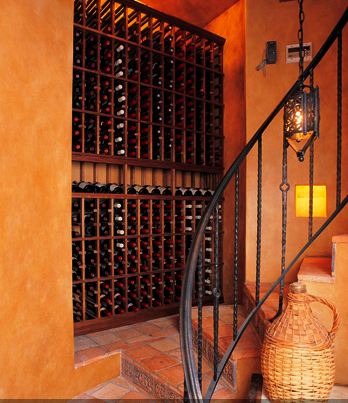
A small area at the base of a staircase was carved out for a few hundred bottles. The addition of a hand forged iron rail, reclaimed terra cotta tile, and layers of apricot venetian plaster brings it to life.

However, there still might not be space for a wine cellar like these. I have one client who found the front hall closet was just perfect for their collection. I quite liked how my coat smelled after it had hung in their for a few hours! So, if you are in this category, check out some of these lovely options.


A coat closet easily becomes a wine cellar - perfect when space is at a premium.
 
Another example of how a small area can be transformed...warm wood, a glass front door, and the right lighting are key elements to any cellar, big or small. 

But, if you're anything like me, your coat closet is so jam packed with coats that you entertain only during the warm season. Don't despair, I have a solution or two for you!


This homeowner took advantage of unused space for this compact wine cubby - it was perfect as the basement is always cool and dry. 
During a recent kitchen remodel, a lover of white wine installed this vertical wine cooler and made room for some red wine as well. 
 
At the end of the day, if all you have is a drawer....than the drawer it is!


Whether you're a serious collector of fine wines - or simply an enthusiast, designing the proper environment for a wine cellar is critical.

Wine is a living organism and like all living things, it needs the proper environment in order to thrive, and to age well. As a result, the storage conditions of the wine are crucial. There are four main environmental factors to consider: temperature, humidity, darkness, and stability.

Temperature: The temperature should remain constant and experts recommend staying within the 55-60 F range. The cooler the temperature, the slower the aging process.

Humidity: Refrigeration is necessary to maintain both temperature, and proper humidity level (50-70%). The corks rely on the dampness in order to stay wet, and to keep the wine properly sealed. 

Darkness: Wine should always be kept from direct sunlight because ultraviolet rays will destroy its color and taste. The cellar should be softly lit, and only when occupied. 

Stability: Stability is key when planning your cellar. Not only is it imperative that the temperature and humidity of the cellar remain stable, but also that there is as little vibration as possible. Vibrations can rob many wines of flavor and bouquet.

Remember, wine cellars are no longer strictly confined to the underground or for the extremely wealthy. Most cellars today are converted from existing spaces as varied as sun rooms, basement work rooms, closets, and garages. So open a bottle and start planning. Cheers! Here's to la chasse au bonheur!

In all my postings, my goal is to provide inspiration and insight into home ownership, real estate, and to provide valuable resources.

Wine Cellar Design/Installations/Sources
APEX Wine Cellars and Racking (racking kits in modular designs)
1-800-462-2714
www.apexwinecellars.com

Braveheart Construction & Remodeling
253-951-2034

Design Wine Cellars
www.vinotemp.com

Pathway Design & Construction
206-937-4809

Vintage Solutions
206-937-5145
www.vintagesolutions.net

Wine Cellar Innovations
Mike Schoech
1-513-335-5755 or 1-800-229-9813

Mural Artist
Ann Fiser
Fiser Fine Arts
425-487-2698

Sunday, September 5, 2010

Letting your personality spill out...


For many of us, Spanx has become the foundation of our wardrobe - it provides the necessary support that holds us together much like the concrete foundation does for our home....so if Spanx is our retaining walls and support beams, than is the front porch our accessories? I think so.

In any given week I see over a 100 homes and when I drive up to a house that has taken their personality and laid it out there for all the world to see, I relish in that moment.


There is a lot to say for "curb appeal" and a lot has been written about it....more from the point of view of increasing the value of your home. As a real estate agent I can't turn my back on this fact, but that's not why we should take some time to "accessorize" our front porch (whether that be a simple stoop, expansive drive, or interior condo door).

The front porch is an opportunity to let others know a little bit about ourselves. I liken it to men's dressing. Men have the choice of navy, charcoal or black. These suits are their foundation but the tie, cuff links and shirt style give us a hint into who they are.

I like the idea that we give a warm personalized welcome to our guests and show a hint of who we are to the world.

The options for decorating your front porch can be as detailed as following the seasons. For some that means going all out, for others it is a simple nod to the season. Either direction, adding seasonal color, foliage and design elements brings it all together.


A dear friend of mine loves to celebrate every holiday and makes certain it spills out over her threshold, creating a warm welcome to friends and family before they enter her house!


I love following the seasons and I love self-expression but my schedule is daunting at times (much like yours I am certain) so I simplified my life by putting an iron bench and two urns on my front porch. As the seasons change so do the bench pillows and plantings.


But a entryway doesn't have to follow the seasons, in fact, an elegant and sophisticated approach is just as wonderful. The point is "who are you and how are you planning to express yourself to the great outside?" Below is  a beautiful example of this. The owner's love of color and sunny disposition shines through this home's classic front door with her gorgeous yellow screen and fun dog statues!


If all you have to work with is a front door, have at it, I say! That's the best place to start. This simple mirror was embellished with fall color and hangs proudly for all who come knocking.


None of this need be expensive. Taking loved items and repurposing them can be a start. And whether you decide to let the porch be a hint of what's to come inside, or wish to celebrate the seasons, accessorizing can be simple and fun....much like searching for the right earrings, scarf or hand bag.

Case in point, this classic Windsor bench from Target is only $339.99.


Adding color and some of your personality is as simple as adding pillows. They can make a bold, or quiet statement that reflects your style


So wear your style on your sleeve and let the world get a glimpse of who you are by putting some personality into your front porch. Not only will you be sending a warm welcome to all who come to visit, you'll be enhancing the value of your home by adding that simple accessory that just makes the outfit!


In all my posting, my goal is to provide inspiration and insight in to home ownership, real estate, and to provide valuable resources. 

Seamstress/Designer
Diana Armitage
HiDi Design
hididesigns@yahoo.com

Designer
Tammara Stroud
Tammara Stroud Design
tammara@tammarastroud.com

Retail/Designer
Pam Robinson
Red Ticking
pam@redticking.com

Containers
Toni Cross
Seasonal Color Spot
toni@seasonalcolorspots.com